National vs Private Universities in Korea: What Tuition Actually Costs
"Is a national university in Korea really cheaper, or is that just something people say?"
It is not just something people say. But the gap is not where most applicants think it is, and the published number is not the number you will pay.
GoKorea Study is not an agency. We do not place students or sell visas. This guide is free information in simple English. Figures below come from Korea's official higher-education disclosure system for 2025 as compiled in our university dataset (180 universities with published tuition). Tuition changes every year and varies by faculty, so always confirm the current figure on the university's own admissions page.
This article is information only. It is not financial or immigration advice.
The Short Answer
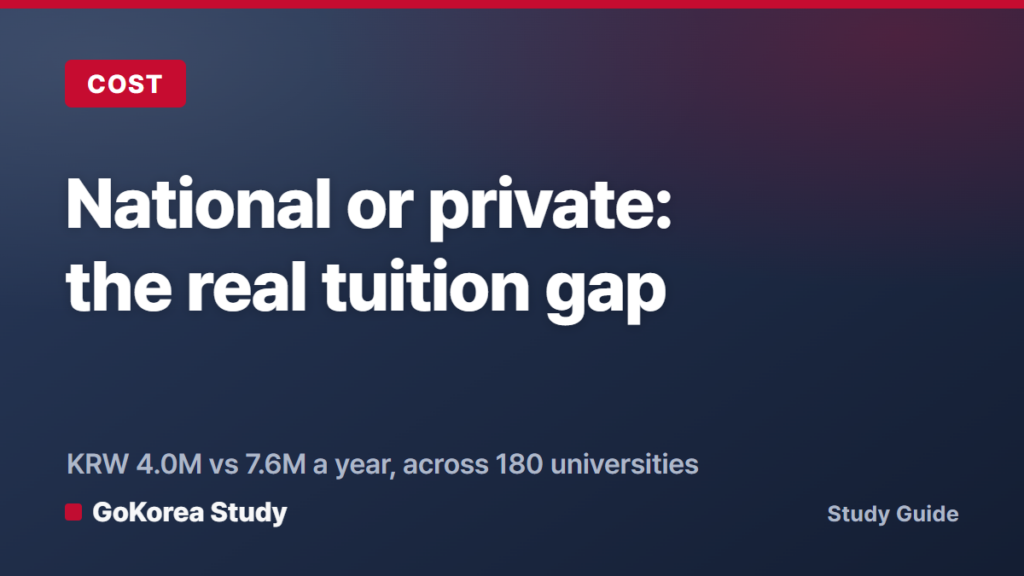
Across the 180 Korean universities in our dataset with published tuition, the average annual figure is roughly KRW 4.0 million at national and public universities and KRW 7.6 million at private universities. That is close to a 1.9x difference.
The lowest figures in the dataset sit under KRW 2 million a year and the highest approach KRW 9.7 million.
Two things this does not tell you: what your department costs, and what you will actually pay after scholarships. Both can move the number more than the national/private label does.
Why the Gap Exists
Don’t want to miss an update?
Join GoKorea Insider — one email when it matters, nothing else.
Korean national and public universities receive government funding that private universities do not. Tuition at national universities has also been held under strong political pressure for more than a decade, which has kept increases small.
Private universities carry more of their cost through tuition. They also tend to have larger campuses, more facilities, and in many cases stronger scholarship budgets — which is why the sticker gap and the paid gap are not the same gap.
Korean universities generally charge domestic and international students the same tuition. This is different from systems where international students pay a separate, higher rate. If you have been comparing Korea to countries with international pricing, the published figure is closer to what you will see on your bill.
The Published Number Is an All-Faculty Average
This is the part that catches applicants out.
The figure a university publishes is usually an average across every faculty. Engineering, medicine, arts and physical education sit well above it. Humanities and social sciences sit below it. At a university averaging KRW 7.6 million, a humanities program might be closer to KRW 6 million and a medical program well past KRW 10 million.
So the average tells you where a university sits overall. It does not tell you what your program costs.
Before you budget, find the faculty-level table. Most Korean universities publish tuition by college (단과대학) and by year of entry, usually under 등록금 or Tuition on the admissions or administration pages.
What the Label Hides in Both Directions
A national university is not automatically the cheaper choice. Some national universities sit in Seoul with high living costs. Some private universities in smaller cities have lower total costs once housing is included, and several run entrance scholarships aimed specifically at international students.
A private university is not automatically expensive. Religious foundations, small specialised institutions, and universities of education can sit at the very bottom of the tuition range regardless of ownership. In our dataset the cheapest institutions overall are not all national.
The useful comparison is not national versus private. It is your department's tuition, minus the scholarship you can realistically get, plus the cost of living in that city.
Scholarships Change the Real Number
Most Korean universities operate entrance scholarships for international students, often tied to language ability or prior academic record, and continuing scholarships tied to your GPA each semester. These are published separately from the tuition table — usually on the international admissions page rather than the tuition page.
That separation is why applicants compare sticker prices and stop there. A private university at KRW 8 million with a 50% entrance scholarship costs less than a national university at KRW 5 million with none.
Check three things on the university's international page:
- Is there an entrance scholarship, and is it automatic or by application?
- What GPA keeps it in later semesters?
- Does it cover tuition only, or tuition plus a stipend?
Living Costs Sit on Top
Tuition is one line. Housing, food, insurance and transport are the rest, and they vary by city more than tuition does.
A dormitory place, where you get one, is usually the cheapest housing available and is billed per semester. Dormitory capacity varies enormously between universities, so do not assume a room is included — we cover how to read that number in our dormitory guide.
National health insurance is mandatory for international students staying long term and is a fixed monthly cost you should budget from month one.
How to Compare Two Universities Properly
- Find each university's tuition for your faculty, not the average.
- Find the entrance scholarship for international students and its renewal condition.
- Check dormitory availability and the per-semester fee, or research local rent.
- Add insurance and transport for that city.
- Note the year of each figure you used.
Do that for two or three universities and the ranking usually changes from what the sticker prices suggested.
Verify Before You Decide
Tuition is set annually and published by the university. Disclosure figures are released on a yearly cycle, so a page you find through search may be showing last year's number without saying so. When two sources disagree, the more recent official disclosure or the university's own current admissions page wins.
Write the year next to every number you plan to make a decision on.
자주 묻는 질문 (FAQ)
Do international students pay more than Korean students? Generally no. Korean universities usually charge the same tuition regardless of nationality. What differs is scholarship access, which is often listed on a separate page.
Is tuition per year or per semester? Universities publish annual figures but bill per semester, so you typically pay about half the annual figure twice a year. Check the payment deadline — missing it can affect enrolment.
Are national universities easier to get into because they are cheaper? Cost and admission difficulty are separate questions. Also note that published competition ratios in Korea refer to the domestic admission pool, not the international one, so they are not a guide to your odds.
Does the tuition figure include the entrance fee? Often not. Many universities charge a one-time entrance fee (입학금) in the first semester in addition to tuition, though this has been reduced or abolished at many institutions. Check the fee table.
Internal links: Cheapest universities in Korea for international students · Dormitory and housing guide · How to choose a Korean university · Scholarships in Korea beyond GKS
Lead magnet CTA: Study in Korea Checklist → GoKorea Insider
Data source: 04-data/universities/quant-data.csv (2025 official disclosure, 180 universities with tuition) · universities.csv (225 universities, university_type)
Become a GoKorea Insider
Free email updates on GKS, universities, visas, and application deadlines — no agency, no spam.