Korean University Application Documents: The Self-Funded Checklist
"Every guide I find is about GKS. I am paying for myself. What do I actually need?"
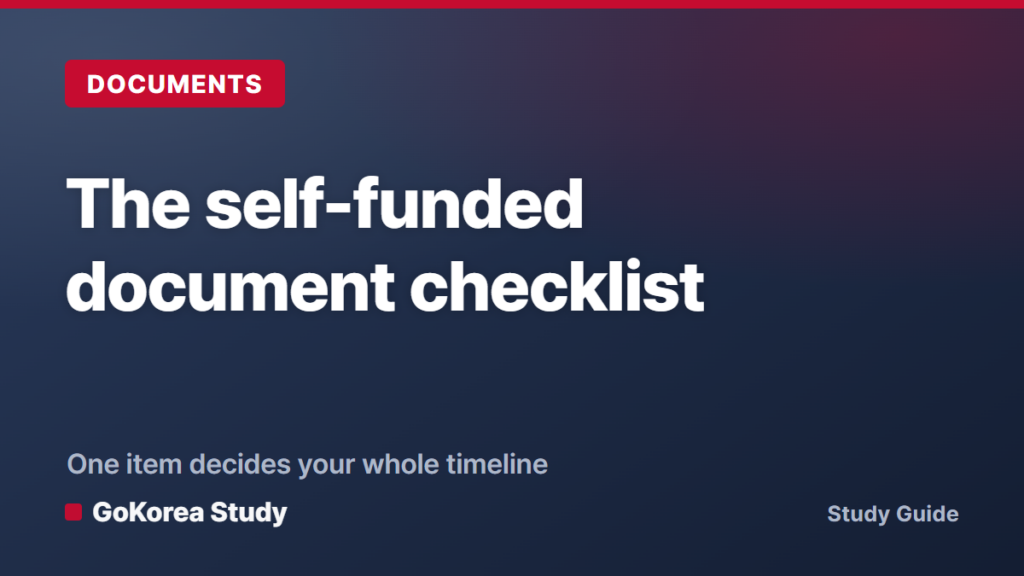
A shorter list than the scholarship one, with one item that can quietly eat six weeks if you start it last.
GoKorea Study is not an agency. We do not place students or sell visas. This guide is free information in simple English. Document requirements are set per university and change every intake, and the university's own admissions guideline is the only list that binds you.
This article is information only. It is not admissions or immigration advice.
The Short Answer
For a self-funded international application to a Korean university, expect roughly this set:
- Application form (usually online, often via a shared portal)
- Diploma or certificate of expected graduation
- Academic transcripts, full record
- Proof of nationality for you and, in many cases, both parents
- Language proof: TOPIK, an English score, or the university's accepted alternative
- Financial proof: a bank balance certificate
- Passport copy
- Self-introduction and study plan
- Photos to Korean specification
- Application fee
Two of these decide your timeline: document authentication and financial proof. Everything else can be produced quickly.
Start With Authentication
Don’t want to miss an update?
Join GoKorea Insider — one email when it matters, nothing else.
Your diploma and transcripts usually need apostille or, for countries outside the Apostille Convention, consular legalisation at the Korean embassy. Some universities additionally accept verification through a recognised credential service.
This step depends on an office you do not control. Processing runs from days to several weeks depending on the country, and it is the single most common reason applications miss a deadline.
Do this first. You can write the study plan while you wait; you cannot make a foreign ministry go faster.
Then Fix Your Name
Before you order translations, decide the spelling.
Your name must be identical across every document — passport, diploma, transcript, bank certificate, application form. A middle name that appears on one paper and not another is a routine reason files come back.
Fix the passport spelling as the master version, then translate everything to match it. Doing this in the other order means paying for translations twice.
Financial Proof: The Part With a Trap
Universities require evidence that you can fund your study, usually a bank balance certificate in your name or a sponsor's, with a supporting relationship document if it is a sponsor's account.
The trap is timing. Immigration and universities expect the funds to have been held for a period, often around a month, rather than deposited days before you apply. A sudden large deposit right before application is a known rejection pattern.
Also note that the amount and format required for admission and for the visa are not always the same. Meeting the university's requirement does not automatically mean you have met the consulate's.
The Study Plan Is Not a Formality
For self-funded applicants the study plan and self-introduction are frequently the only place a human forms an impression of you.
Reviewers read them together and compare what you say about your past against what you claim you will do in Korea. A plan that names a specific department, a specific reason for that department, and a coherent next step reads as an application. A plan about loving Korean culture reads as a template.
Write the study plan first, then edit the self-introduction so it points at it.
Photos and Small Things That Delay People
- Photos to Korean ID specification, usually 3.5 x 4.5cm, plain background, recent. Reused visa photos are often rejected.
- Translation into Korean or English by a certified translator where the original is in neither.
- Original vs copy. Some universities require originals, and some do not return them. Never send the only copy of a certificate that cannot be reissued.
- Application fee paid by the method the university specifies; international transfer fees can delay confirmation.
Order of Operations
Work backwards from the deadline:
- Deadline minus 8 weeks. request apostille or consular legalisation; confirm passport name spelling.
- Minus 6 weeks. start the study plan; deposit funds if the balance needs seasoning.
- Minus 4 weeks. certified translations, matched to the passport spelling.
- Minus 2 weeks. assemble everything, check name consistency across every page, pay the fee.
- Deadline. Submit, and keep scans of everything you sent.
The only stage you fully control is the writing. Everything else depends on someone else's queue.
After Admission Comes the Visa
Admission and the D-2 visa are two separate processes. Your acceptance letter and the university-issued documents feed the visa application, which has its own financial and document requirements and is handled by the Korean embassy or consulate for your country.
Budget time between the two. Students who treat the offer as the finish line often discover the visa timeline afterwards.
The Guideline Wins Where We Differ
Every university publishes an international admission guideline per intake, listing exactly which documents it wants, in what form, and by when. Where this article and that guideline differ, the guideline wins.
Read your department's page too — some departments add requirements such as a portfolio, an audition, or a research proposal.
자주 묻는 질문 (FAQ)
Do I need my parents' documents? Many Korean universities require proof that the applicant and both parents are non-Korean nationals for the international admission track. Check your university's wording.
How much do I need in the bank? It varies by university and by visa requirement, and the two are not always the same figure. Take the number from the current guideline, and hold the funds rather than depositing them just before applying.
Is apostille always required? It depends on your country and the university. Countries outside the Apostille Convention use consular legalisation instead. Some universities accept a credential verification service.
Can I apply before I graduate? Usually yes, with a certificate of expected graduation, and you submit the final diploma and transcript later. Missing that later deadline can cancel your admission.
Do I need TOPIK? Not always. Many universities publish alternatives, including English scores and their own tests; we cover this in a separate guide.
Internal links: Applying without TOPIK · Korean university application timeline · Korean student visa full guide · Financial proof for the student visa · How to choose a Korean university
Lead magnet CTA: Study in Korea Checklist → GoKorea Insider
Data source: 04-data/universities/universities.csv (admission_type, language_requirements) · 04-data/visa-guides/visa-guides.csv (D-2 common_mistakes, required_documents)
Become a GoKorea Insider
Free email updates on GKS, universities, visas, and application deadlines — no agency, no spam.