GKS-Designated Universities: What the Label Means and How to Use It
"I found a university I love. Can I just apply for GKS and go there?"
Only if that university is on the designated list for your round. And the list is not the same thing as "good universities in Korea."
GoKorea Study is not an agency. We do not place students or sell visas. This guide is free information in simple English. The designation counts below come from our own dataset of 225 Korean universities; the authoritative list for any given round is published by NIIED in that round's official guideline at studyinkorea.go.kr.
This article is information only. It is not admissions or immigration advice.
The Short Answer
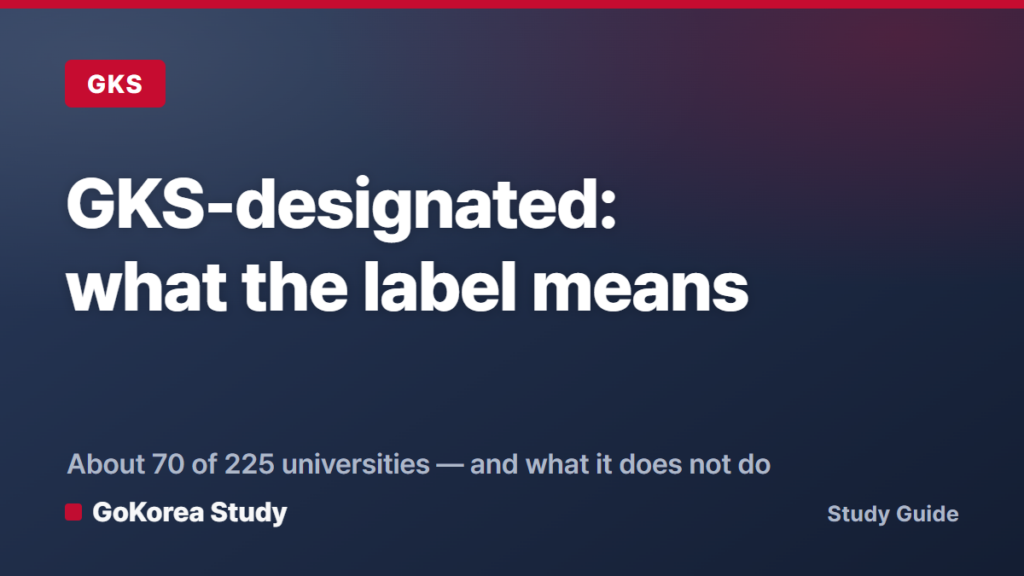
Roughly 70 of the 225 Korean universities in our dataset carry a GKS designation, about one in three.
Designation means NIIED has approved that university to receive GKS scholars. It is a prerequisite, not a recommendation. It tells you the scholarship can be used there, and nothing about whether your major exists there, whether the department teaches in a language you have, or whether you would be happy in that city.
Critically, the list changes by round, and it can differ between the two tracks. Always take it from the current guideline, never from an older blog post or a previous year's PDF.
Why the List Is Not Just "Top Universities"
Don’t want to miss an update?
Join GoKorea Insider — one email when it matters, nothing else.
Applicants often assume the designated list is a ranking in disguise. Designation actually reflects a university's capacity and willingness to host scholarship students: international office capability, dormitory provision, Korean language support, and administrative track record. A mid-sized regional university with a strong international office can be designated while a famous institution is not, or is designated only for certain degree levels.
This is good news for applicants: your realistic list is broader than the handful of names everyone recognises.
The Two Tracks Use the List Differently
Embassy Track. You apply through the Korean embassy in your home country and may name up to three universities from the designated list. Selection at this stage runs under your country's own allocation, which NIIED publishes per round.
University Track. You apply directly to one designated university, which does the screening. One name means one attempt, so the fit between your background and that specific department matters more than anywhere else.
You cannot apply through both tracks in the same round. Choosing the door is the first real decision in a GKS application; we cover it in a separate guide.
How to Build Your Shortlist
Work in this order. Most applicants do it backwards and lose time.
- Start from the current designated list, not from a wish list. Anything not on it is not an option this round, however good it is.
- Filter by degree level. Some universities are designated for graduate study but not undergraduate, or vice versa.
- Filter by whether your major exists there, and in which language. A program taught only in Korean is not a candidate if you have no Korean and the round does not include a language year that gets you there.
- Read the department page, not the university page. It tells you which professors are there, what the curriculum contains, and whether the program admits international students regularly.
- Only then rank by preference.
What Designation Does Not Cover
- Admission. A designated university still applies its own academic screening. GKS selection and university admission are two gates.
- English instruction. Designation says nothing about the language of your program.
- Permanence. Lists are set per round.
- Every department. Some universities host GKS scholars only in specific colleges.
Where Applicants Lose Time
Building a shortlist from a previous year's list. Choosing three universities in the same city and field on Embassy Track, which wastes the risk-absorption those three choices are for. And ignoring the language of instruction until after selection; finding out in August that your program runs entirely in Korean is a bad time to find out.
The Two Sources That Decide Your Application
NIIED publishes the participating university list, the quota by country, the required documents, and the deadlines in each round's guideline at studyinkorea.go.kr. Embassy pages for your country publish the local submission process, which can differ. Everything else, including this article, is orientation.
자주 묻는 질문 (FAQ)
Can I apply to a university that is not designated? Not with GKS. You can apply to it as a self-funded or university-scholarship applicant through the normal international admission process.
Is a designated university better than a non-designated one? No. Designation reflects capacity to host scholarship students, not academic quality.
Internal links: Embassy Track vs University Track · GKS complete guide · GKS country quotas · GKS timeline · GKS eligibility and GPA
Lead magnet CTA: GKS Success Guide → GoKorea Insider
Data source: 04-data/universities/universities.csv (225 universities, gks_availability) · authoritative list = NIIED round guideline, studyinkorea.go.kr
Become a GoKorea Insider
Free email updates on GKS, universities, visas, and application deadlines — no agency, no spam.