Applying to a Korean University Without TOPIK: What Actually Counts
"I want to start in Korea next year, but I have not taken TOPIK yet. Is it already too late?"
Probably not. The idea that every Korean university requires TOPIK before you can apply is one of the most common wrong assumptions in this process.
GoKorea Study is not an agency. We do not place students or sell visas. This guide is free information in simple English, based on the published language requirements of 225 Korean universities in our dataset. Requirements change every intake and vary by department, so always confirm on the university's own admissions guideline.
This article is information only. It is not admissions or immigration advice.
The Short Answer
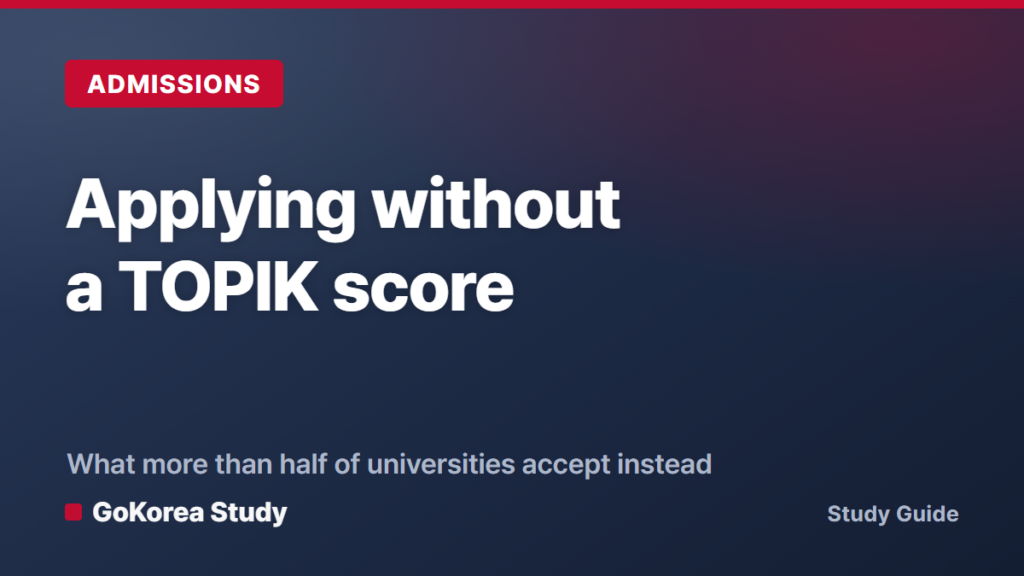
Of the 225 universities in our dataset, 136 explicitly mention an alternative to TOPIK in their published language requirements — most commonly IELTS, TOEFL, or a CEFR level, and often the university's own Korean test or a certified language-institute completion.
86 universities publish an English-taught track, where the entry language proof is an English score rather than a Korean level at all.
So "no TOPIK" does not mean "no options." It means you need to read requirements per university instead of assuming a single national rule.
The Four Doors Universities Actually Open
Don’t want to miss an update?
Join GoKorea Insider — one email when it matters, nothing else.
Published requirements usually fall into one of these:
1. TOPIK level. The most common route. Undergraduate admission commonly sits at TOPIK Level 3, with some departments requiring higher — Korean literature, creative writing, and Korean-content programs often require Level 5 or 6.
2. An English score instead. Many universities accept IELTS or TOEFL in place of a Korean level. Published floors are frequently around IELTS 5.5 or TOEFL iBT 71, but every university sets its own and some sit higher.
3. The university's own Korean test. A number of universities run an in-house Korean proficiency test for applicants who have not taken TOPIK, sometimes administered right before the intake.
4. A language-institute certificate. Completing a set level at the university's own Korean language institute, at a King Sejong Institute, or at an IEQAS-certified university program is accepted by many institutions in place of a TOPIK score.
The fourth door is the one applicants most often overlook, and it is also the one that changes your timeline — because it means arriving on a D-4 language visa first and moving into a degree afterwards.
The English Track Is a Different Thing
An English-taught track is not the same as "they accept my IELTS for a Korean-taught program."
In a genuine English track the degree itself is delivered in English. Entry proof is an English score. In the second case you are being admitted into a Korean-taught program with a language waiver at entry, and you will sit in Korean lectures from week one.
Read carefully which one you are applying to. The admissions page will usually say language of instruction (강의 언어) somewhere, and if it does not, ask the international office directly.
We cover what an English track does and does not cover in a separate guide.
Entry and Graduation Are Two Different Bars
This is the trap.
A university can admit you with an English score and still require a Korean level to graduate. That requirement is usually written in the academic regulations (학칙) rather than on the admissions page, which is exactly why applicants miss it.
A common pattern: admission at TOPIK 3 or an English equivalent, graduation at TOPIK 4. You have the whole degree to close that gap, but you have to know it exists on day one, because leaving it to the final year is how students end up delaying graduation.
Before you accept an offer, search the university's regulations for a graduation language clause, or ask the international office this exact question: "Is there a Korean language requirement for graduation, and what level?"
TOPIK Still Matters After Admission
Even where TOPIK is not required to get in, it does work later:
- Part-time work hours. The part-time work permit ties your allowed weekly hours to Korean ability. Meeting the Korean-ability standard raises the cap significantly, and manufacturing part-time work requires a higher level.
- Scholarships. Many entrance and continuing scholarships for international students use TOPIK level as a criterion.
- Graduation, as above.
- Staying in Korea afterwards. Korean ability adds points in the points-based residence route, and it makes the job search materially easier.
The accurate summary, then, is that you may not need TOPIK to apply, and you will want it soon after. Treating it as optional for the whole degree is the mistake.
What to Do If You Have No TOPIK and a Deadline
- Filter by requirement, not by ranking. Build your shortlist from universities whose published requirement you can actually meet this intake.
- Check whether an English score you already hold qualifies. If you have IELTS or TOEFL from a previous application, you may already be eligible somewhere.
- Ask about the in-house test. If a university runs one, that can be faster than waiting for the next TOPIK sitting.
- Consider the language-visa route deliberately, not as a fallback. A year on D-4 at the university's own institute often converts into that university's degree program smoothly, and you arrive at the degree with the Korean you will need anyway.
- Book TOPIK regardless. Sittings are limited and fill up. Having a score removes constraints later even if it was not needed to apply.
Three Pages to Check Before Deciding
There is no single national language rule for admission. There is a set of university rules, and inside each university a set of department exceptions.
Check three pages before deciding: the international admissions guideline for your intake, the department page for your major, and the academic regulations for graduation requirements.
자주 묻는 질문 (FAQ)
Is TOPIK required for the D-2 student visa? No Korean level is required for the D-2 visa itself. The requirement, where it exists, comes from the university, not the visa.
What TOPIK level do most undergraduate programs ask for? Level 3 is the most common published floor for Korean-taught undergraduate admission, with Korean-language and humanities departments often requiring more. Confirm per department.
Can I use IELTS for a Korean-taught program? Some universities allow it as an admission alternative. Whether that is wise is a separate question — you will still be attending lectures in Korean.
If I study at a Korean language institute first, does that guarantee admission? No. Completing a level can satisfy the language requirement, but you still apply through the normal international admission process.
Internal links: English-taught universities in Korea · Korean language requirements at Korean universities · D-4 language visa · TOPIK for GKS · Part-time work permit
Lead magnet CTA: Study in Korea Checklist → GoKorea Insider
Data source: 04-data/universities/universities.csv (225 universities, language_requirements, english_track_available) · 04-data/visa-guides/visa-guides.csv (D-2 korean_requirement)
Become a GoKorea Insider
Free email updates on GKS, universities, visas, and application deadlines — no agency, no spam.